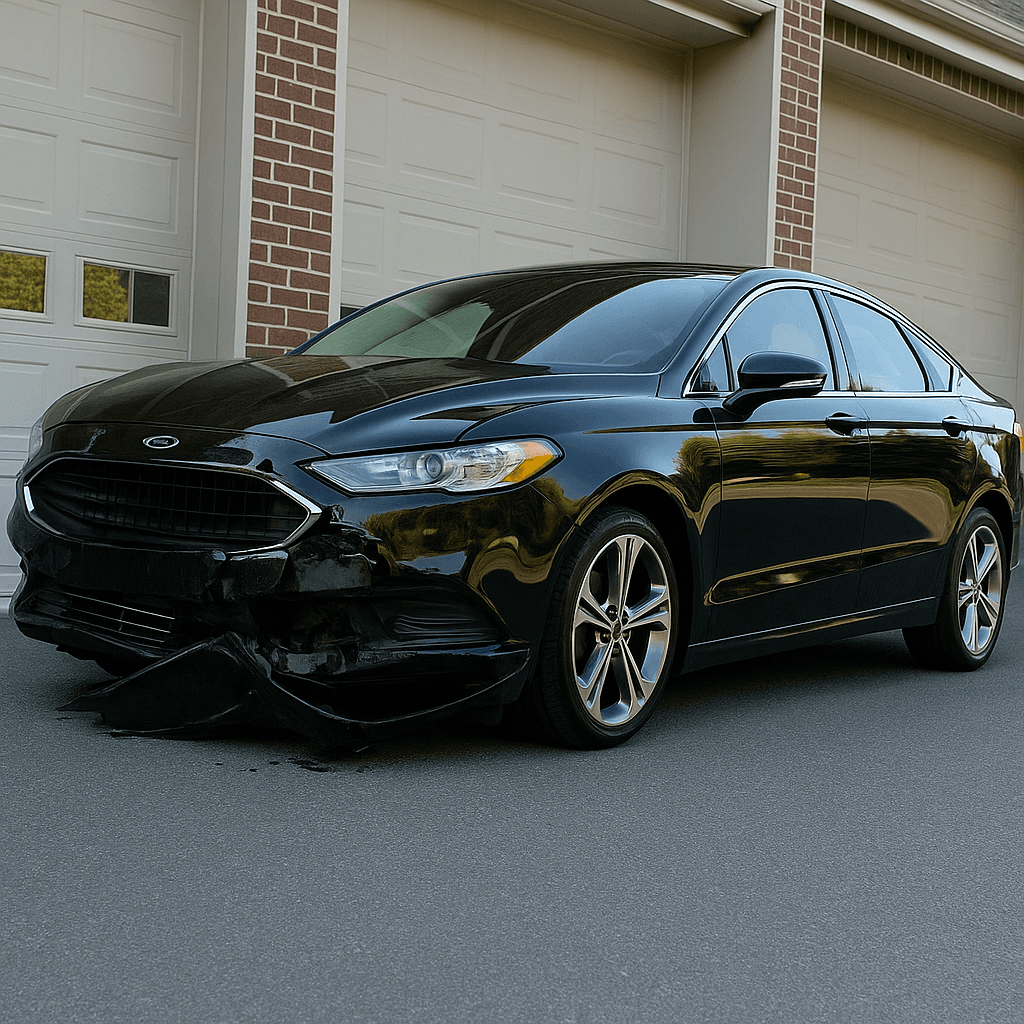
You paid off your 2012 sedan years ago, but you're still paying $60/mo for comprehensive and collision coverage on a vehicle worth $4,200. Here's the calculation that tells you when full coverage stops making financial sense.
The Two-Year Breakeven Test Most Agents Won't Show You
Your 2014 Toyota Camry has a trade-in value of $5,800. You're paying $52/mo for comprehensive coverage with a $500 deductible. If the car were totaled tomorrow, your insurer would pay you $5,300 after the deductible — but you'll pay $1,248 over the next two years for that coverage. The honest breakeven calculation: you're paying 24% of your maximum possible payout every two years, and that percentage climbs as your vehicle ages.
Most insurance calculators tell you to drop comprehensive when repair costs approach the vehicle's value, but that's backward for retirees on fixed income. The right question is whether the annual premium cost — often $500 to $900 per year for comprehensive and collision combined on vehicles 10+ years old — justifies the net payout you'd receive after deductible if you filed a total loss claim. For a vehicle worth $6,000 with a $1,000 deductible, you're insuring a maximum $5,000 benefit. If your combined comp/collision premium is $700 annually, you'll recover your premium cost in a total loss only if the vehicle lasts fewer than seven years without a claim.
The actuarial reality: comprehensive claims are relatively rare for careful drivers who park in garages. According to Insurance Information Institute data, the average driver files a comprehensive claim once every 10-12 years. If you've gone a decade without filing a theft, vandalism, or weather-related claim, you've likely paid more in premiums than you'd recover even in a worst-case scenario.
How Vehicle Age and Declining Value Change the Math After 65
A vehicle loses roughly 15-25% of its value every year for the first five years, then 10-15% annually thereafter. By year ten, depreciation slows — but your comprehensive premium often doesn't drop proportionally. Insurers base rates partly on vehicle age and value, but also on repair costs, theft rates for that model, and regional claim frequency. A 2013 Honda Accord might be worth $6,500 today, but if it's frequently targeted for catalytic converter theft in your area, your comprehensive premium may stay elevated even as the vehicle's actual cash value declines.
Here's the specific calculation for drivers 65 and older: total your annual comprehensive and collision premiums, subtract them from your vehicle's current market value (use Kelley Blue Book or NADA trade-in value, not retail), then subtract your deductible. If the remaining amount is less than three years of premium payments, you're likely paying more to insure the vehicle than you'd recover in a total loss. For a $4,800 vehicle with $650/year in comp/collision premiums and a $500 deductible, your maximum net benefit is $4,300 — which you'll pay in premiums over 6.6 years. If you plan to drive the vehicle longer than that, you're self-insuring either way.
State-specific factors matter. In Florida, comprehensive coverage costs 20-30% more than the national average due to hurricane and flood risk. In Michigan, comprehensive rates dropped significantly after 2020 no-fault reforms, making it more cost-effective to maintain coverage longer. Montana and Wyoming drivers face higher comprehensive costs due to animal collision frequency — a factor that doesn't decline as your vehicle ages.
Compare rates from carriers that specialize in senior drivers
Mature driver discounts, low-mileage rates, and coverage reviews — see what you're actually eligible for.
Get Your Free Quote✓ Mature Driver Discounts✓ No Obligation✓ Licensed Carriers✓ All 50 States
What You Keep vs. What You Drop: The Liability Firewall
Dropping comprehensive and collision coverage does not mean dropping insurance entirely — and this distinction is critical for senior drivers who may face higher liability judgments due to perceived "deep pockets" from retirement savings. You must maintain your state's minimum liability coverage, and frankly, those minimums are dangerously low. Many states still allow 25/50/25 liability limits — $25,000 per person for injury, $50,000 per accident, $25,000 for property damage. A single moderate injury claim can exceed that in under 48 hours of hospitalization.
The coverage you should never drop: liability insurance, and ideally at 100/300/100 limits or higher. The annual cost difference between minimum liability and 100/300/100 is typically $150-$280 for drivers 65+ with clean records — a small premium for protection against a lawsuit that could reach your retirement accounts, home equity, or other assets. Uninsured motorist coverage remains essential as well, particularly in states like Florida (26.7% uninsured), Mississippi (29.4%), or New Mexico (21.8%), where the likelihood of being hit by an uninsured driver is substantial.
What you can safely drop on a paid-off vehicle worth under $7,000: comprehensive (covers theft, vandalism, weather, fire, animal strikes) and collision (covers damage from accidents regardless of fault). If you have an emergency fund covering $4,000-$6,000 and can afford to replace the vehicle out of pocket if it's totaled, you're effectively self-insuring — and likely saving $600-$1,100 annually depending on your state, vehicle, and driving record. That saving, compounded over five years at even modest returns, often exceeds the vehicle's current value.
When It Still Makes Sense to Keep Comprehensive After 70
Three scenarios justify maintaining comprehensive coverage on older vehicles even when the breakeven math looks marginal. First: you live in a high-theft area and your vehicle model appears on the National Insurance Crime Bureau's most-stolen list. Catalytic converter theft has spiked 300%+ since 2020, and certain models — particularly 2004-2010 Toyota Prius, 2001-2021 Honda Accord, and 1985-2021 Ford F-Series trucks — are targeted at dramatically higher rates. If your vehicle is on that list and you park on the street, comprehensive coverage may pay for itself in a single claim.
Second: you live in a region with severe weather exposure — Gulf Coast hurricane zones, Midwest tornado alleys, or areas with frequent hailstorms like Colorado's Front Range or the Texas Panhandle. A single hail event can total a vehicle, and these events often affect entire neighborhoods simultaneously, creating claim backlogs that can take months to process. If you lack the liquid savings to replace your vehicle immediately after a weather event, maintaining comprehensive coverage provides cash flow protection even if the long-term math is break-even.
Third: your vehicle has unusual value retention or specialized use. Some models — particularly Toyota Tacoma, 4Runner, certain Subaru Outback years, and Honda CR-V — depreciate unusually slowly or have strong regional demand that keeps resale values elevated. If your 2012 vehicle is still worth $9,000+ due to model-specific demand, and your annual comprehensive premium is under $400, the coverage remains cost-justified. Similarly, if you use the vehicle for medical appointments, grocery trips, or other essential errands and couldn't easily absorb a sudden replacement cost, the peace of mind may justify the premium even when the actuarial math is neutral.
How to Adjust Coverage in Stages Rather Than All at Once
You don't have to make a binary choice between full coverage and liability-only. Many insurers allow you to increase deductibles incrementally, which preserves catastrophic protection while lowering premiums. Raising your comprehensive deductible from $250 to $1,000 typically reduces your premium by 30-40%, and raising collision deductibles to $1,000 or $1,500 can cut that portion of your premium by 35-50%. For a driver paying $840/year for comp/collision, moving to $1,000 deductibles might drop the cost to $520/year — a middle path that maintains coverage for total loss events while reducing annual cost.
Another staged approach: drop collision first, keep comprehensive. Collision coverage protects you if you cause an accident or hit a stationary object — events where fault is often yours. If you're a confident driver with a clean record, decades of experience, and you drive fewer than 6,000 miles per year, your collision risk is relatively low. Comprehensive coverage, by contrast, protects against events entirely outside your control: theft, fire, falling objects, weather. For many senior drivers, comprehensive-only coverage (retaining comp, dropping collision) costs $280-$450 annually and protects against the events most likely to total an older vehicle without warning.
If you're unsure, run the math annually. Each year at renewal, check your vehicle's current market value using Kelley Blue Book or NADA, compare it against your annual comp/collision premium plus deductible, and recalculate the breakeven timeline. When your vehicle's value drops below 4-5 times your annual premium cost, it's time to seriously consider dropping physical damage coverage. Document the calculation in your insurance file so you're making the decision based on data, not guesswork or agent pressure.
State-Specific Programs and Requirements That Affect This Decision
Some states mandate coverage retention if you have an auto loan or lease — but once your vehicle is paid off, those requirements vanish and you regain full control over your coverage choices. However, state-specific senior driver programs can change the cost equation. California requires insurers to offer mature driver course discounts of up to 10%, which can reduce your comprehensive and collision premiums by $60-$110 annually — potentially extending the period where full coverage remains cost-effective. Florida statute 627.0645 mandates discounts for drivers 55+ who complete an approved driver improvement course, with savings typically 5-10% for three years.
Some states also regulate how aggressively insurers can increase rates based on age alone. Hawaii, Massachusetts, and Michigan restrict age-based rate increases for drivers with clean records, meaning your comprehensive premium may stay stable longer than in states with minimal age rating restrictions. Conversely, states like Nevada, Montana, and South Carolina allow more pronounced age-based rating, which can accelerate the point at which comprehensive coverage becomes financially unjustifiable on older vehicles.
Your state may also affect your liability calculation. In North Carolina and Virginia, injury claim settlement averages run 15-25% higher than national norms, making higher liability limits more critical — and freeing up more of your budget to drop physical damage coverage on older vehicles. If you're evaluating this decision, check your specific state's requirements and available senior discounts — the math shifts significantly based on where you live and what programs you're eligible for but may not be currently using.